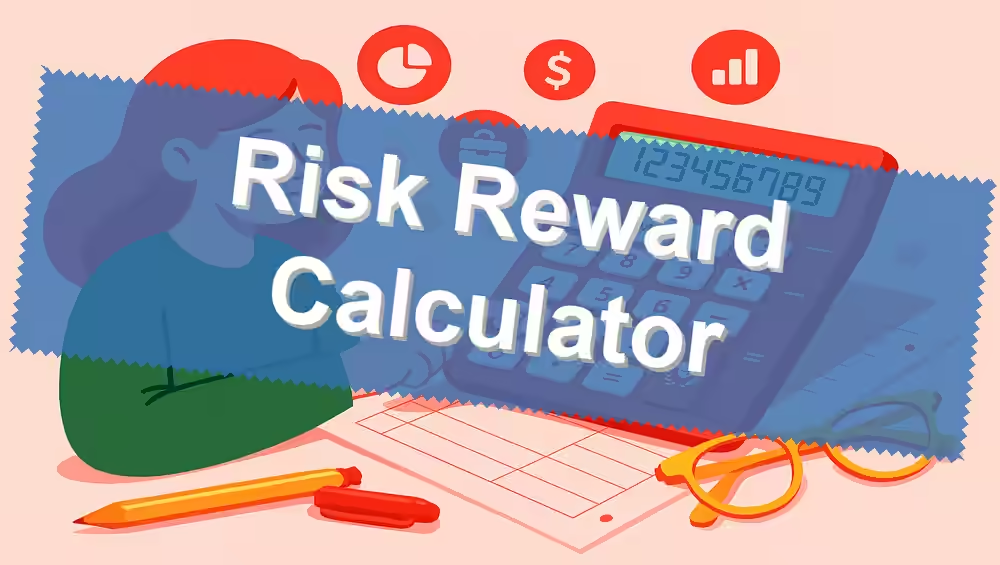
Understanding the relationship between risk and reward is crucial for success in the investment and financial markets. Investors can use the Risk Reward Calculator to compare the potential benefits of an investment with the risks involved. You can make wiser decisions with the help of this calculator since it shows you exactly what you stand to gain or lose. No matter your level of experience as an investor, your financial plan can be greatly impacted by a thorough understanding of the risk-reward relationship. The opening delivers focus once the risk reward calculator sets context.
If you want to know what could happen to your investments, the Risk Reward Calculator is a better way to do the math than any other tool. By selecting parameters such as the entry price, exit price, and stop-loss levels, you can obtain a comprehensive view of the risk-reward ratio. This ratio is a crucial metric for determining the potential reward for the risk you’re taking. It’s an essential component of risk management for traders and investors.
Meaning of Risk Reward
There is no separation between risk and reward when it comes to investing. The uncertainty and potential loss of capital constitute risk. The fate of your financial plan hinges on the level of uncertainty you face. In contrast, the reward refers to the anticipated financial gain or return on investment. The middle ground between the two is the risk-reward ratio.
The risk-reward ratio is an easy-to-understand yet highly practical concept. You can see the potential gain or loss from an investment in the risk-reward ratio. If you stand to gain $1,000 but stand to lose $500, your risk-reward ratio is 2:1. That is to say, you have the opportunity to earn $2 for every $1 you stake. To determine if an investment is worthwhile, knowing this ratio is useful.
Another Example of Risk Reward Calculator
Imagine a more intricate scenario with multiple investments. The hypothetical investor has a mix of equities, bonds, and a mutual fund. Every one of these assets has its own unique risk-reward profile. An investment’s risk and return can be determined with the help of a risk return calculator. You can reduce your vulnerability to any one type of risk by spreading your investments out in this way.
You can adjust your portfolio to achieve a more balanced risk-reward profile, for instance, if the risk-reward ratio of your equities is higher than that of your bonds. In this approach, you may maximize your returns with minimal risk. In order to make data-driven judgments, the Risk Reward Calculator simplifies these complex matters.
How does Risk Reward Calculator Work?
You can input your investment details into the Risk Reward Calculator, and it will calculate the potential risks and rewards. Important details such as the entrance price, exit price, and stop-loss level are typically required. Next, the risk-reward ratio is calculated using these data by the calculator. You can use this ratio to determine if the potential reward is sufficient to justify the risk you’re taking.
The process consists of several stages. You begin by inputting your investment details, such as the present price, your goal price, and the level of your stop-loss. The calculator then uses these criteria to determine the potential gain or loss in terms of money. At last, it calculates the risk-reward ratio, which might help you make wise decisions. Investors and traders who require a quick and accurate way to predict the outcome of their deals will find this tool invaluable.
Formula for Risk Reward Calculator
The risk-reward ratio is easy to calculate. A potential profit can be calculated by subtracting the entrance price from the target price. Deduct the stop-loss level from the entry price to get the potential loss. Then, divide the potential gain by the potential loss to get the risk-reward ratio.
The equation for the risk-reward ratio is (possible profit divided by possible loss). If the potential gain is $10 and the potential loss is $5, then the risk-reward ratio is 2:1. Using this ratio, you may determine if the potential reward justifies the risk. You can quickly and accurately determine the potential outcomes for your assets with the help of the Risk Reward Calculator because it does this automatically.
Benefits of Risk Reward
The ability to diversify your holdings is a major perk. By understanding the potential benefits and drawbacks of each investment, you can construct a portfolio that aligns with your risk appetite and long-term financial objectives. This allows you to minimize risks while maximizing returns on your assets. Additionally, it provides an easy-to-understand framework for evaluating investment opportunities, which facilitates the identification of promising assets.
Clearer Investment Goals
Your financial objectives can be better defined with the use of a Risk Reward Calculator. When you weigh the potential advantages and hazards, you may establish more realistic investment objectives. This can help you avoid becoming sidetracked by temporary market fluctuations and instead concentrate on your long-term financial objectives. Additionally, it provides an easy-to-understand framework for evaluating investment opportunities, which facilitates the identification of promising assets.
Better Risk Management
Knowing the risk-reward ratio is essential for effective risk management. By understanding the potential benefits and drawbacks of an investment, you can establish appropriate levels for stop-loss orders and target prices. This will assist you in managing your risks more effectively and avoiding significant losses. Additionally, you can adjust your investment strategy as required to remain within your risk tolerance.
Enhanced Portfolio Balance
You can find a better investment balance with the help of the Risk Reward Calculator. By understanding the potential benefits and drawbacks of each investment, you may construct a portfolio that corresponds to your risk appetite and financial objectives. This allows you to minimize risks while maximizing returns on your assets. In addition to making your portfolio more diverse and balanced, it prevents you from being overly exposed to any one type of risk.
Disadvantages of Risk Reward
While the Risk Reward Calculator does have its advantages, it does have its disadvantages as well. Among its many flaws is its reliance on assumptions and historical data, neither of which are always reliable for foretelling the future. Because of how fast market conditions can change, the calculator might miss some potential aspects. Furthermore, it has the potential to oversimplify complex investment scenarios, which could result in inaccurate or insufficient assessments.
Oversimplification of Complex Scenarios
Inadequate or incorrect assessments may result from the Risk Reward Calculator’s tendency to simplify complex investing scenarios. If it merely considers the risk-reward ratio, it might miss some potential outcomes. This is often a major problem in complex or dynamic marketplaces. For a more complete view, use the calculator in conjunction with other tools and factors in a larger analysis.
Over-reliance on Data
A major concern with the Risk Reward Calculator is the potential for individuals to become overly reliant on statistics. You can see the potential risks and rewards in numbers with the calculator, but it may miss the nuanced qualitative details. Forgetting important details because people are overly dependent on data is a real risk. If you want to make sure your findings are well-rounded, you should use the calculator as only one tool among several.
Lack of Emotional Considerations
The Risk Reward Calculator has a major flaw in that it disregards emotions. Investing typically requires gut feelings, and a calculator might not be able to reveal how those emotions impact the final tally. Think about your emotions and your comfort level with risk when making financial decisions. The calculator can provide a more comprehensive and balanced view when combined with additional tools.
Recommended Calculators
FAQ
What is the Risk-reward Ratio?
One method to weigh the potential gain from an investment against the potential loss is the risk-reward ratio. Simply divide the potential gain by the potential loss to get it. An essential component of risk management, this ratio tells you whether the potential gain is worth the danger you’re taking.
How Do I Use the Risk Reward Calculator?
The Risk Reward Calculator requires accurate input, such as the entry price, exit price, and stop-loss level. The calculator then uses these factors to determine the potential profit or loss as well as the risk-reward ratio. Using this ratio, you may make informed investing decisions.
What are the Benefits of Using a Risk Reward Calculator?
You may improve your decision-making, risk management, portfolio balancing, financial goal-setting, emotional investing, and self-confidence by using a Risk Reward Calculator. It provides a quantifiable and transparent lens through which to view investment opportunities, allowing you to make more informed decisions.
What are the Disadvantages of Using a Risk Reward Calculator?
Risk Reward Calculators have their limitations, such as an over-reliance on data, static assumptions, omission of external elements, oversimplification of complex situations, disregard of emotions, and reliance on outdated data. You should use the calculator in conjunction with other tools and analysis to obtain a clearer view.
Conclusion
The Risk Reward Calculator is an essential tool for every trader or investor. You may make better decisions by using it as a transparent and quantifiable tool to assess the potential benefits and drawbacks of an investment. Knowing the risk-reward ratio can help you set reasonable goals, improve your portfolio management, and maintain focus on your long-term financial objectives. As we conclude, the risk reward calculator keeps the discussion concise.