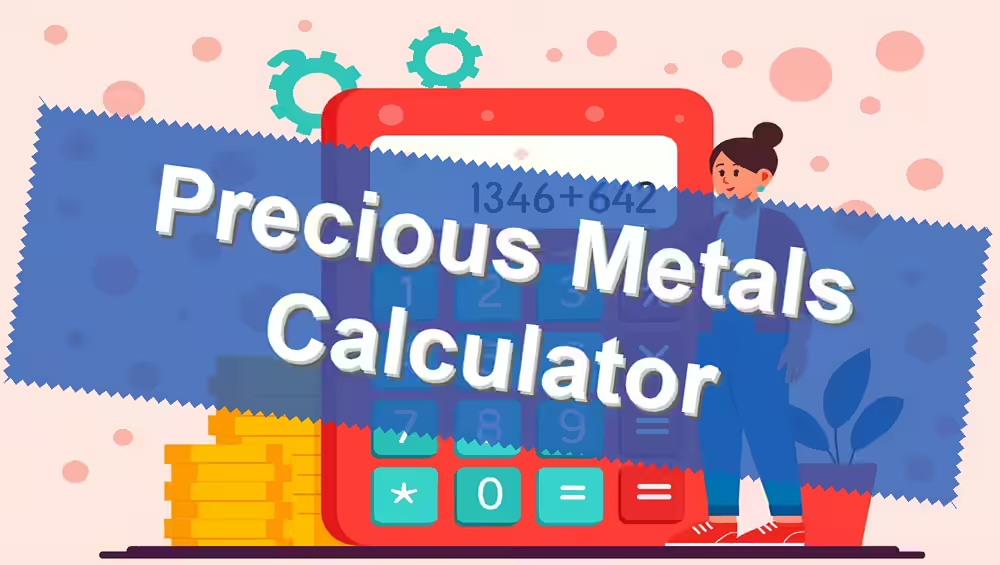
Use a precious metals calculator if you’re thinking about investing in gold, silver, platinum, or any of the other precious metals. Whether you’re an experienced investor or just starting out, knowing how to calculate the value and potential returns of precious metals will help you make wise decisions. Enter details like the metal’s present price, your desired investment amount, and your expected rate of return into this tool. This will show you the long-term performance of your investment quite clearly. The topic stands clearly defined under the precious metals calculator.
A precious metals calculator’s ability to provide speedy comparisons of various investment options is one of its greatest strengths. By entering the data for multiple metals, you can locate the one with the highest potential ROI. In times of economic uncertainty, when more conventional assets like stocks and bonds might not be a good bet, this can be a lifesaver. One solid way to diversify your portfolio is with precious metals, which have historically provided a safe haven for investors during market volatility.
Meaning of Precious Metals
The term “precious metals” refers to a class of metals that include a number of extremely valuable and uncommon elements. These metals are commonly used to create ornamental items such as jewelry, coins, and more due to their durability and attractive appearance. But there’s more to them than meets the eye. Additionally, precious metals are attractive investment options because of their historical track record of stable value.
Pretty almost everyone is familiar with gold, silver, and platinum. The value of these metals has been high for centuries, and they are still widely seen to be a sound investment even in a down economy. Many industrial applications also make use of them due to their excellent conductivity and resistance to corrosion. Electronics make use of gold, whereas solar panels and photography rely on silver. Conversely, catalytic converters used in automobiles often contain platinum.
Examples of Precious Metals Calculator
Users can input specifics regarding their precious metal assets into the advanced Precious Metals Calculator. If you’re interested in purchasing gold, for instance, you can input the current price per ounce, the quantity you wish to purchase, and the duration you wish to retain it. The ROI calculator will then provide you with a ballpark figure after factoring in storage costs and the likelihood of an increase in value.
So, what if you were to invest $1,800 in 10 ounces of gold? You anticipate that the gold’s worth will increase by 5% annually while you hold on to it for five years. By factoring in the upfront purchase, storage fees, and projected growth, you can utilize the calculator to determine the future value of your investment. You will be able to make more informed decisions based on this improved picture of your investment’s potential performance over time.
Calculating the potential return on investment (ROI) for silver is another example. Simply plug in the different prices, storage costs, and expected appreciation rates to see how buying silver bars instead of coins stacks up. By considering all important factors, you can find the option that is most likely to yield a satisfactory return on investment. It’s a great way to maximize your return on investment.
How does Precious Metals Calculator Works?
By feeding the user a number of parameters, the Precious Metals Calculator is able to apply financial algorithms to make predictions about the future of precious metals prices and returns. To determine the potential return on investment (ROI), the calculator considers the present price of the precious metal, the quantity you wish to purchase, and the duration you intend to keep it. It factors in additional costs like storage fees and the likelihood of the item’s value increasing as well.
Inputting the current price per ounce, the desired quantity of ounces, and the projected annual growth rate are the three main components of a platinum purchase order. The calculator then estimates the future value of your investment based on this data, the initial cost, and any additional costs. You may now make more informed decisions regarding your precious metals investments based on this precise estimate of your potential return on investment.
That it can deal with many kinds of situations is another crucial element about the calculator. For instance, you can play around with the expected holding period and appreciation rate to see how different values impact the potential returns. Because of this leeway, you can experiment with several investment strategies until you find the one that helps you achieve your financial objectives. In addition, it’s a great way to put your investment theories to the test and ensure that you’re prepared for market fluctuations.
Formula for Precious Metals Calculator
To estimate the potential future value and profit of your investment, the Precious Metals Calculator employs a number of financial algorithms. Among the most crucial formulas is the one for future value. Using a predetermined rate of return, it estimates the future value of an investment. This calculation takes into account the initial investment, the expected yearly return, and the duration of the investment. The calculator may provide you with a ballpark figure for the potential value of your precious metal investment using this method.
One such important formula is the present value formula. It gives you the present value of an amount of money that will be invested in the future at a specific rate of return. To estimate the impact of inflation on your investment, you can use this formula. As a popular hedge against economic downturns, precious metals often maintain their worth even as prices rise. With the use of the present value calculation, the calculator can show you how your investment could fare in various inflation scenarios. A clearer view of its possibilities in the future will emerge from this.
Additional expenses, such as storage fees, are also factored into the calculator. Over time, these fees could add up if you possess a significant amount of precious metals. You may get a more accurate picture of your potential earnings because the calculator factors in these costs. In this way, you can better plan your investments and avoid unpleasant financial surprises. Plus, it’s a great way to consolidate all of your financial data and stay on top of things.
Benefits of Precious Metals
Being easy to sell is another major advantage. Precious metals are a nice investment since they are easy to buy and sell. Any precious metal—gold, silver, platinum, you name it—can be quickly and simply converted into cash from your investment. If other investments are difficult to sell due to market volatility, this liquidity will be invaluable. Plus, it’s a great method for safeguarding your funds for those unexpected moments.
Industrial Demand
The wide variety of products that employ precious metals keeps their worth high and drives up demand. Examples of silver’s uses include photography and solar panels, while gold’s superior electrical conductivity makes it a popular choice in electronics. Automobile catalytic converters rely on platinum because of its ability to reduce harmful emissions. This industrial demand ensures that precious metals will never go out of style, regardless of demand from investors. Because of this, precious metals can provide a steady return for investors regardless of the state of the economy.
Historical Value Retention
The fact that the value of precious metals has historically been relatively stable is a great argument in their favor. Precious metals, such as gold and silver, have always been popular because to their rarity and aesthetic value. They have always been a reliable spot to put money away, regardless of the state of the economy, due to their inherent worth. The value of gold, which has served as a medium of exchange for countless generations, has remained relatively constant. With this background information, investors may rest easy knowing that their investments have a track record of retaining value.
Global Acceptance
Investing in precious metals is a smart move because of their universal acceptability and value. The United States, Europe, and Asia are just a few of the places where precious metals like gold and silver are exchanged and acknowledged. You may purchase and sell precious metals easily from any location in the world because this is something that everyone agrees on. Because of this, investors have greater opportunities to buy and sell on a global scale. Furthermore, this proves that precious metals may still provide a secure return on investment, regardless of the state of the global economy.
Disadvantages of Precious Metals
Although precious metals have many advantages, it is important to consider their potential disadvantages as well. One of their major issues is their instability. You run the risk of losing money if the market moves against you and the price of precious metals drops. Particularly for those without investment experience, precious metals provide a high degree of risk due to their extreme volatility. Furthermore, unlike other investment options, precious metals do not generate income in the form of dividends or interest.
No Income Generation
Unlike stocks and bonds, precious metals do not generate income in the form of dividends or interest. Investors can only profit from a price increase, then. For those seeking consistent returns on their assets, this might provide a significant challenge. When the market is down, it could be difficult to see the use in holding onto precious metals for the long haul if they aren’t going to generate any income. But for some investors, this is a cost they’re willing to pay for the security of a genuine asset and the possibility of a large profit.
Price Volatility
The volatility of precious metal prices is a major drawback of investing in these commodities. You run the risk of losing money if the market moves against you because precious metal prices are very volatile. Particularly for those without experience investing, precious metals provide a high degree of risk due to their extreme volatility. The market, global events, and economic statistics can all have a significant impact on the rapid rise and fall of the price of gold, for example. This level of volatility could provide a challenge for investors seeking more consistent returns. A thorough understanding of the market and a strategy for mitigating risk are prerequisites to purchasing precious metals.
Storage and Insurance Costs
The expense of storing and insuring a large quantity of precious metals can quickly add up. Because of their potential impact on your total profit, these additional costs should be carefully considered when purchasing precious metals. Consider the expense and potential requirement for insurance when considering the storage of valuables like gold bars or coins in a secure vault. Because of their potential impact on your returns, you should factor these costs into your investment strategy. Shipping and processing fees can also drive up the price of precious metal possessions.
Recommended Calculators
FAQ
What is a Precious Metals Calculator?
The Precious Metals Calculator is a tool that can help investors determine the potential returns on investments in precious metals including gold, silver, and platinum. To see the long-term performance of an investment, users can input data such the metal’s current price, their desired investment amount, and their expected profit. Everyone from novices to seasoned investors can benefit from this tool when it comes to making informed choices.
How Does the Precious Metals Calculator Work?
The Precious Metals Calculator makes predictions about future values and returns based on a variety of user-supplied data points and financial algorithmic models. By plugging in the price of the precious metal, the quantity you like to purchase, and the duration you wish to hold it, you may utilize the calculator to determine the potential profit. To provide a comprehensive view of the investment’s potential performance, it also considers additional expenses like storage fees and the likelihood of its value increasing.
What Factors Should I Consider When Using the Precious Metals Calculator?
When you use the Precious Metals Calculator, keep a few things in mind. Discovering the metal’s current spot price should be your first step. Right now, you may buy or sell the metal at this price. Next, decide on the desired unit of measurement for the metal, be it ounces, grams, or something else entirely. Think about how much you’ll have to pay to keep the metal, how long you intend to keep it, and how much its worth could rise or fall over time. A more accurate estimate of your potential earnings can be obtained from this.
Can the Precious Metals Calculator Help with Tax Planning?
If you want to know how your investment can influence your tax situation, you can use the Precious Metals Calculator to figure it out. When you purchase or sell precious metals, you can be subject to capital gains taxes in your home state or another jurisdiction. You can modify your investing strategy in light of the estimated costs of these fees that you can find using the calculator. In this way, you may better manage your investments and avoid unpleasant financial surprises. You should also be aware that the tax implications of investing in precious metals can vary greatly depending on the metal type and the manner in which you hold it.
Conclusion
Finally, if you’re looking to purchase precious metals like gold, silver, platinum, or any of the others, you must need the Precious Metals Calculator. With its help, comparing investment opportunities, seeing their impact on inflation, and factoring in taxes and fees is a breeze. You may devote more time and effort to other aspects of your investment strategy, such research and market analysis, with the help of this calculator. It’s a great method to organize your finances and keep everything in its proper place. As we finish, the precious metals calculator leaves the topic well defined.