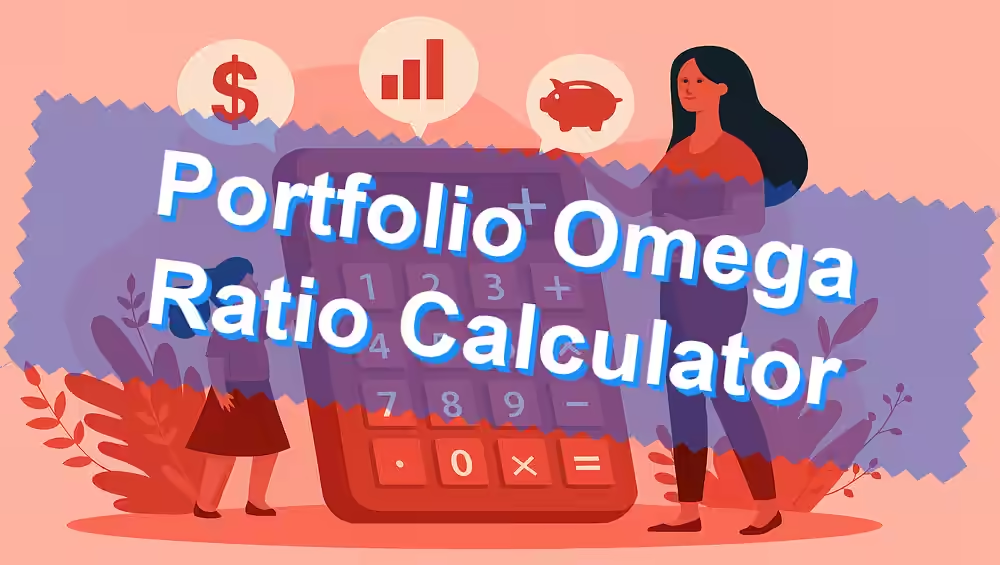
In the complex world of investing, it could be difficult to determine the performance of your portfolio. To help with this process, there are tools like the Portfolio Omega Ratio Calculator. By improving their understanding of risk-adjusted returns, this tool aims to help investors make more informed decisions. No matter your level of expertise as an investor, this calculator can assist you in refining your strategy. Understand the advantages of using the portfolio omega ratio calculator over manual methods.
A powerful metric that surpasses both the Sharpe and Sortino ratios is the Omega Ratio. The potential benefits and drawbacks of an investment can be better assessed in this way. You can predict your portfolio’s performance in various market conditions with the help of the Portfolio Omega Ratio Calculator. Depending on your risk tolerance and long-term financial objectives, this can lead you to reevaluate your investment strategy.
Meaning of Portfolio Omega Ratio
As a performance indicator, the Portfolio Omega Ratio provides a more comprehensive analysis of an investment’s risk and return. While other metrics focus on average returns, the Omega Ratio considers the full spectrum of returns. This means that it takes into account the potential for both gains and losses, providing a more complete picture of your portfolio’s health.
The Omega Ratio is a simple comparison of the probabilities of receiving returns above and below a specified level. It is common practice to use the risk-free rate or the lowest acceptable return as the cutoff. Investors can use the Omega Ratio to determine the probability of achieving their desired returns while simultaneously considering the possibility of incurring losses. Because of this, it can help you maximize your portfolio and reduce risk.
Examples of Portfolio Omega Ratio Calculator
Imagine that you are comparing two mutual funds. Although Fund A’s volatility is higher, its average return is higher. Fund B is more stable, although it has smaller returns. Portfolio Omega Ratio Calculator allows you to compare the two funds after you enter a minimum return. Using the calculator, you may determine the probability that each fund will achieve a return more than or equal to the threshold. Based on your risk tolerance and financial objectives, this can guide you in selecting the fund that is a good fit.
One further example would be to examine the performance of a hedge fund. Hedge funds frequently employ intricate strategies that have the potential to greatly disrupt the market. Consider the potential benefits and drawbacks of different approaches with the help of the Omega Ratio. Setting a threshold return and considering the likelihood of losing money might help you determine the likelihood of getting the returns you desire. This is crucial for making prudent investing decisions in a highly volatile market.
Envision yourself as a private investor whose holdings include equities, bonds, and property. The Portfolio Omega Ratio Calculator allows you to track the performance of different asset classes. When you pick a threshold return, you can see how likely it is that each asset class will earn returns above it compared to returns below it. Your portfolio’s performance can increase as a result of your improved decision-making about asset allocation and risk management.
How does Portfolio Omega Ratio Calculator Works?
Looking at the odds of earning returns above and below a specified level is how the Portfolio Omega Ratio Calculator works. The standard cutoff is either the risk-free rate or the lowest acceptable return. To determine these probabilities, the calculator looks at historical return data, which improves your overall picture of the performance of your portfolio. With this knowledge, you may make wiser decisions regarding your money.
Inputting your portfolio’s return data into the calculator is the initial step. You should additionally provide the desired result. The likelihood of returns being above the threshold and below it are determined by the calculator after it examines the return distribution. The potential benefits and drawbacks of your investment portfolio are laid out for you here.
When compared to other portfolios or benchmarks, the Omega Ratio provides insight into the performance of your investment portfolio. The better the risk-return profile, the higher the Omega Ratio. This reduces the likelihood of returns below the threshold while increasing the likelihood of returns beyond it for the portfolio. Managing risk and making your portfolio better are both helped by the Omega Ratio for this reason.
Formula for Portfolio Omega Ratio Calculator
A straightforward and highly practical formula is provided by the Portfolio Omega Ratio Calculator. What this means is that you should consider both the likelihood of receiving returns above a certain level and the likelihood of receiving returns below that level. Well, here’s the formula: Divide the integral from negative infinity to the threshold of (threshold – 1 – R) dF(R) by the integral from the threshold to infinity of (1 + R – threshold) dF(R), and you get the Omega Ratio. The cumulative distribution function of the returns is denoted by F(R) in this case, where R represents the return.
The upper figure represents the anticipated gain beyond the threshold, and the lower figure represents the anticipated loss below the barrier. There’s no rocket science here. Dividing these two figures yields the Omega Ratio. It reveals the degree to which your investment is susceptible to price fluctuations. Because of this, it can help you maximize your portfolio and reduce risk. Verify that your return threshold is well-defined and that your historical data is correct.
Various investment strategies and portfolios can have their Omega Ratios calculated using the above formula. This will allow you to compare their performance and make more informed decisions. You can compare two mutual funds by finding their Omega Ratios. A higher Omega Ratio indicates that the fund has a lower risk of making returns below the threshold and a higher likelihood of making returns above it.
Benefits of Portfolio Omega Ratio
Among its many advantages is the possibility that it can help investors make more informed decisions. Knowing the likelihood of getting the returns one desires allows investors to modify their investment strategies to suit their risk tolerance and financial objectives. In dynamic markets, where conventional metrics could obscure the true nature of the risks and potential benefits, this is of paramount importance. Investors can also utilize the Omega Ratio to compare various investment strategies and portfolios, ultimately leading them to the optimal answer. The fact that it’s simple to use and grasp is still another plus. Although the Omega Ratio approach relies on statistical concepts, a Portfolio Omega Ratio Calculator makes it possible for anyone, regardless of financial expertise, to utilize the strategy. Because of this, the offering can reach a larger range of investors who can benefit from its insights. Numerous investment vehicles, such as stocks, bonds, property, and more, can make use of the Omega Ratio.
Versatility Across Asset Classes
The Portfolio Omega Ratio is applicable to many different types of investments, including stocks, bonds, property, and more. Its adaptability allows investors to track the performance of many asset classes, making it a valuable tool for diverse portfolios. Using the Omega Ratios, you may identify the investments that are significantly increasing your total return and risk. With this, you can maximize the potential of your investment portfolio.
Simplicity and Accessibility
You can utilize a Portfolio Omega Ratio Calculator without having a deep understanding of finance, even though the Omega Ratio is based on some statistical concepts. This broadens access to the technology, which in turn allows more investors to benefit from its insights. Because of how simple the Omega Ratio is, it facilitates conversations regarding the potential benefits and drawbacks of investments with clients and other stakeholders.
Comparative Analysis
A further advantage of the Omega Ratio is its applicability in comparing various investing strategies or portfolios. Using the Omega Ratio to compare each option will help you identify the ones with the most favorable risk-reward profile. Those in the financial advisory or fund management industries who are responsible for evaluating a wide range of investment opportunities for their clients may find this feature very useful. If you want to improve your recommendations and your clients’ portfolio performance, you should look into the Omega Ratio’s comparative research.
Disadvantages of Portfolio Omega Ratio
While there are many positive aspects of the Portfolio Omega Ratio, investors should also be aware of its negative aspects. The fact that it is based on historical data is one of the main issues. The Omega Ratio takes performance from the past into account, which isn’t necessarily indicative of future success. This is an issue with many performance metrics, but it should be considered when using the Omega Ratio as a tool for investment decision-making. The results may also alter if you adjust the Omega Ratio to a different threshold return.
Sensitivity to Threshold Choice
The outcomes are sensitive to the Omega Ratio, which is itself affected by the threshold return you select. Common examples of such a threshold include the risk-free rate and the minimum acceptable return. The precise number chosen has a significant impact on the Omega Ratio. Because picking the incorrect criterion could cause investors to make inaccurate risk and return projections, investors should give serious consideration to the appropriate threshold for their scenario. If you want this to be successful, you need to have extensive knowledge of the investing industry and your financial objectives.
Reliance on Historical Data
The Portfolio Omega Ratio relies on historical data, which is a major drawback of the method. Determining the Omega Ratio based on past performance isn’t necessarily a foolproof method for forecasting future outcomes. When considering the Omega Ratio as an investment metric, bear in mind that this is a common issue with many performance measures. Due to the fluid nature of the market and the fact that historical results are no guarantee of future results, jumping to the wrong conclusions based on them is risky business.
Limited Short-term Evaluation
When it comes to measuring short-term success, the Portfolio Omega Ratio may not be the most helpful metric. Investors with a long-term horizon will benefit from it because it takes the complete distribution of returns into account. You might not get the precise data you need to evaluate short-term success using the Omega Ratio. Alternative metrics that focus on shorter time periods may be more appropriate in some contexts. However, investors with a longer time horizon can still benefit from the Omega Ratio.
Recommended Calculators
FAQ
What is the Portfolio Omega Ratio?
Returns over a certain level are considered more likely than returns below that level according to the Portfolio Omega Ratio, a performance metric. By considering all returns, not just the averages, it paints a clearer picture of your portfolio’s risk and return. This makes it a valuable asset for enhancing your portfolio and controlling risk.
How Do I Calculate the Omega Ratio?
Using historical return data and a predetermined threshold return, one may calculate the Omega Ratio. The calculation considers the expected gain beyond the threshold as well as the expected loss below it. The method relies on specific statistical concepts, but with the help of a Portfolio Omega Ratio Calculator, even those without a background in finance will be able to utilize it. Get your past data straight and establish a defined threshold return; these are the two most critical things.
What are the Benefits of Using the Portfolio Omega Ratio?
Among the several benefits of the Portfolio Omega Ratio are its comprehensive risk assessment, improved decision-making, versatility, user-friendliness, and capacity to measure performance over time. Investors may maximize their portfolio returns and make more informed decisions with the help of the Omega Ratio, which highlights potential risks and benefits. Those who are in it for the long haul and want peace of mind in their investments will find it particularly useful.
What are the Disadvantages of the Portfolio Omega Ratio?
The Portfolio Omega Ratio has a number of drawbacks, such as its reliance on historical data, sensitivity to the choice of threshold return, difficulty in calculation, applicability to short-term evaluations only, interpretability issues, and volatility in response to market conditions. Despite these caveats, the Omega Ratio can be a helpful performance metric when used in conjunction with others and under the correct circumstances.
Conclusion
You may find out how your investments are doing with the help of the Portfolio Omega Ratio Calculator. With a comprehensive view of the potential risks and benefits associated with each investment, it aids investors in making smarter decisions and optimizing their portfolios. Whether you’re in control of a small personal portfolio or a large institutional fund, knowing how to use this calculator can considerably improve your investment plan. Those planning to invest for the long haul will find it particularly useful in maintaining a robust portfolio and achieving their financial objectives. The proficiency with the portfolio omega ratio calculator will undoubtedly enhance your analytical capabilities.