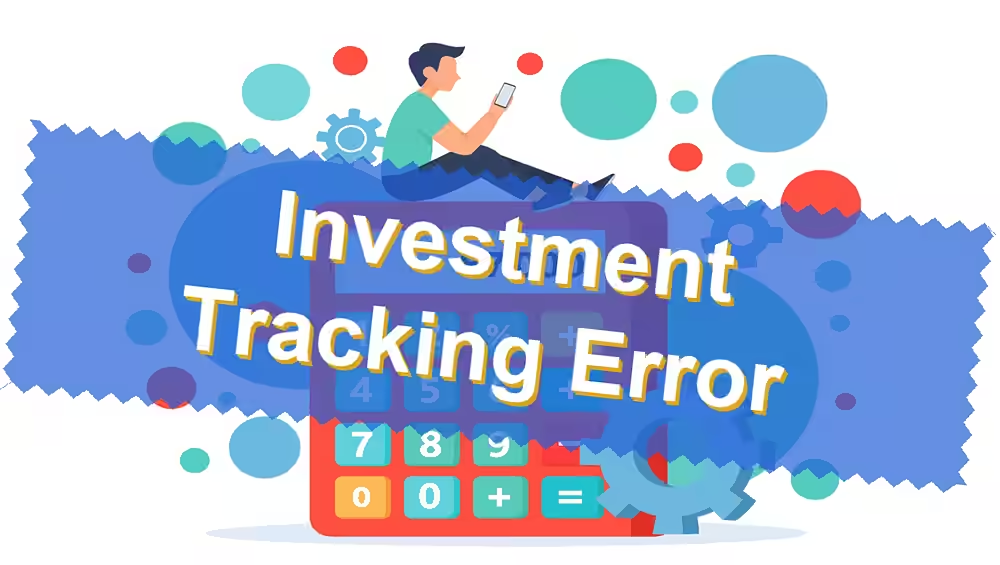
In order to make educated decisions as an investor, you’ll often need to sift through mountains of data and signs. This includes the investment tracking inaccuracy among other measures. When compared to its benchmark, it reveals the portfolio’s performance. This theory can greatly affect investors’ investment strategies, thus it’s important for them to be aware of it. Simply put, tracking error is the standard deviation of the gaps between a portfolio’s returns and its benchmark’s returns. A portfolio’s adherence to its plan can be observed through this method. The discussion feels structured under the investment tracking error calculator.
You may see how far off track your fund is from the S&P 500’s returns using the tracking error if you’re managing a fund that attempts to mimic its performance. This can be a great tool for keeping your investment strategy on course. However, knowing the risks is just as important as keeping an eye on your progress. Your portfolio may be taking on more risk than you anticipated, increasing the likelihood of unexpected losses, if the tracking error is large.
Meaning of Investment Tracking Error
One measure of a portfolio’s performance relative to its benchmark is the investment tracking error. It reveals the degree to which a portfolio is maintaining its original strategy. You can use the tracking error to see how much your fund’s returns deviate from the S&P 500’s returns if you’re managing a fund that aims to mirror the returns of the S&P 500. Assuring that your investment strategy remains on course can be greatly aided by this.
The tracking error can be calculated by taking the standard deviation of the returns that differ from the benchmark and the portfolio over a specific time period. You can use this information to assess the portfolio’s level of risk. Your portfolio may be taking on more risk than you anticipated, increasing the likelihood of unexpected losses, if its tracking error is significant. You can tell your portfolio is doing well relative to its benchmark if its tracking error is small. If the benchmark is performing well, this is typically a good sign.
Examples of Investment Tracking Error Calculator
You can find out where you went wrong with your tracking with the help of the investment tracking error calculator. It calculates everything for you based on the information you provide it, including your portfolio results and the benchmark. Your portfolio’s adherence to the strategy you laid out for it can be more easily observed in this way. If you’re in control of a fund that aims to outperform the FTSE 100, for instance, the calculator can help you quickly determine the tracking error, allowing you to make informed decisions.
You should see yourself as an independent investor who has a diverse portfolio of assets. To compare your portfolio’s performance to that of a broad market index, such the S&P 500, you can utilize an investment tracking error calculator. By inputting the returns of both your portfolio and the index, you may determine the amount of your tracking error. If you do this, you may be able to identify your shortcomings and adjust your investment strategy accordingly. Make sure your investments are performing as you expect them to by keeping a close eye on them.
Expert fund managers rely on the investment tracking error calculator. It allows companies to monitor the performance of their funds and ensure that they remain aligned with their benchmarks. Measuring the tracking inaccuracy on a regular basis allows fund managers to make data-driven decisions and improve their investing approach. Both the fund and its investors will benefit from this.
How does Investment Tracking Error Calculator Works?
Over a predetermined time frame, the investment tracking error calculator takes into account both your portfolio’s and the benchmark’s returns. After that, it calculates the relative dissimilarities of these returns over all time intervals. The tracking error can then be calculated as the standard deviation of these variations. The calculator simplifies the process by doing all the heavy lifting for you, which is easier than it sounds. The tracking error amount can be easily calculated by entering your information into the calculator.
The ability to handle large amounts of data is a great feature of the investment tracking error calculator. For professional fund managers, who often need to monitor the performance of multiple funds, this is a godsend. Entering the returns of each fund and its benchmarks allows the calculator to quickly determine the tracking error for each fund. Because of this, fund managers may rectify any errors and adjust their investing strategies accordingly.
Both novice investors and seasoned fund managers will find the investment tracking error calculator to be user-friendly. In most cases, it comes with an easy-to-navigate interface that provides quick results when you input your data. Thus, it is a great tool for anyone who wants to monitor the progress of their investments and ensure they remain on course. No matter the size of your portfolio, the calculator can assist you in making wise decisions.
Formula for Investment Tracking Error Calculator
Finding the formula for investment tracking inaccuracy requires a few steps. It all starts with gathering the returns data for both your portfolio and the benchmark over a specific time period. All of this data should be collected at the same intervals and for the same amount of time (say, once a month). The next step is to determine the percentage by which the portfolio’s returns deviate from the benchmark’s returns across each period. These differences are then joined together after being squared. Last but not least, to determine the tracking error, you divide the sum by the number of intervals and then square the result.
Here is one possible way to express the formula: Where N is the total number of periods and di is the period-to-period return differential between the portfolio and the benchmark. This seems like a lot of work, but all it really involves is determining the standard deviation of the returns that differ between the portfolio and the benchmark. You can see how closely your portfolio is tracking your goals with this.
Because it does the arithmetic for you, the investment tracking error calculator simplifies this process. The tracking error amount can be easily calculated by entering your information into the calculator. Because of this, monitoring the progress of your investment and ensuring that you are on the right route becomes much easier. Whether you have a little or large portfolio, the calculator can assist you in making sensible decisions. Make sure your investments are performing as you expect them to by keeping a close eye on them.
Benefits of Investment Tracking Error
Keeping tabs on financial mistakes has several benefits. To keep investment plans on course, it is useful to see how closely a portfolio follows its benchmark. As a result, individual investors can rectify any issues that arise. To ensure they are providing investors with the returns they promised, professional fund managers use it as a tool to track the performance of their funds.
Helps in Evaluating Performance
The inaccuracy of investment tracking allows you to observe the performance of your portfolio, which is one of its primary advantages. By comparing the returns of the portfolio to its benchmark, investors can gain insight into the performance of their assets. This is a great tool for identifying discrepancies and implementing necessary adjustments. It may be necessary to refine the investment approach, for instance, if the portfolio’s results significantly deviate from the benchmark.
Improves Decision Making
Better judgments can be made with the help of investment tracking error, which shows how closely a portfolio follows its benchmark. If there are any errors, you can fix them with this tool. If a portfolio’s returns significantly deviate from the benchmark, for instance, it may be necessary to adjust the investment approach. By routinely monitoring the tracking error, investors can improve their trading techniques and make more informed picks.
Enhances Transparency
An easy way to see how closely a portfolio is doing in relation to its benchmark is through tracking error, which increases transparency. Investors and fund managers alike should take note of this. It provides insight into the performance of assets for individual investors. It ensures that investors are receiving the returns that professional fund managers promise. Investors can stay informed and adjust their approach as needed by regularly monitoring the tracking error.
Disadvantages of Investment Tracking Error
There are many benefits to investment tracking inaccuracy, but there are also certain drawbacks that investors need to be aware of. The fact that investors are unable to change it in response to changes in the market is one of the major issues. For instance, just because the market is very volatile doesn’t imply poor performance if the tracking error is substantial. Additionally, tracking inaccuracy might be influenced by the choice of benchmark, leading to rare erroneous conclusions. Understanding these boundaries and combining tracking inaccuracy with other metrics can help paint a clearer picture.
Benchmark Choice
Which benchmark you use can also affect the tracking error. You can get inaccurate results if you use the wrong kind of benchmark; there are many. For instance, because to the portfolio’s increased concentration, it may have a significant tracking inaccuracy when contrasted with a broad market index. It is critical to choose a benchmark that accurately reflects the investing approach and goals of the portfolio. Because of this, we know that tracking error is a reliable metric for evaluating performance.
Data Requirements
For the purpose of determining investment tracking inaccuracy, full and precise data is required. Included in this data set are the returns for the benchmark and the portfolio for the specified time frame. Compiling this data can be a tedious and meticulous process. Also, check that the information is up-to-date and accurate. Misleading tracking error findings can be caused by data errors or discrepancies. Because of this, it is essential to verify the data and utilize reputable sources before determining the tracking error.
Market Conditions
The fact that it is susceptible to market fluctuations is one of the main drawbacks of investment tracking mistake. For example, market volatility could explain a large tracking error, which does not necessarily mean poor performance. Therefore, while examining tracking error, it is crucial to consider the current status of the market. Tracking error is one of several critical metrics to consider when evaluating a portfolio’s performance.
Recommended Calculators
FAQ
What is Investment Tracking Error?
One approach to measure the dispersion of a portfolio’s results relative to its benchmark is the investment tracking error. To determine it, we take the standard deviation of the returns gap between the portfolio and the benchmark for a certain time frame. Here you can observe the degree to which the portfolio is adhering to its strategy.
Why is Tracking Error Important?
In order to monitor the performance of your portfolio and ensure it remains consistent with its benchmark, tracking inaccuracy is essential. If you want to make informed judgments and fine-tune your investing approach, this will show you just how closely your portfolio is following your plan.
How Do I Calculate Tracking Error?
You need a set amount of time and the benchmark’s and your portfolio’s return data in order to calculate the tracking error. Finding the gaps between the portfolio’s returns and the benchmark’s returns for each time period is the next step. The remaining steps involve squaring and adding the discrepancies. After dividing the sum by the number of intervals, the tracking error can be calculated by taking the square root.
What is a Good Tracking Error?
Your investment strategy and benchmark will determine what constitutes a decent tracking error. The closer the portfolio follows its benchmark, the lower the tracking error, which is generally a good sign. However, you shouldn’t ignore other factors, such as the assets’ quality and the earnings following risk mitigation.
Conclusion
The investment tracking error is a useful metric for monitoring a portfolio’s performance relative to its benchmark. For data-driven decision-making and method-enhancing investment, it paints a clear picture of the portfolio’s adherence to its planned strategy. Understanding and monitoring tracking inaccuracy can be beneficial for both individual investors and professional fund managers. This ending keeps the message clear with the investment tracking error calculator.