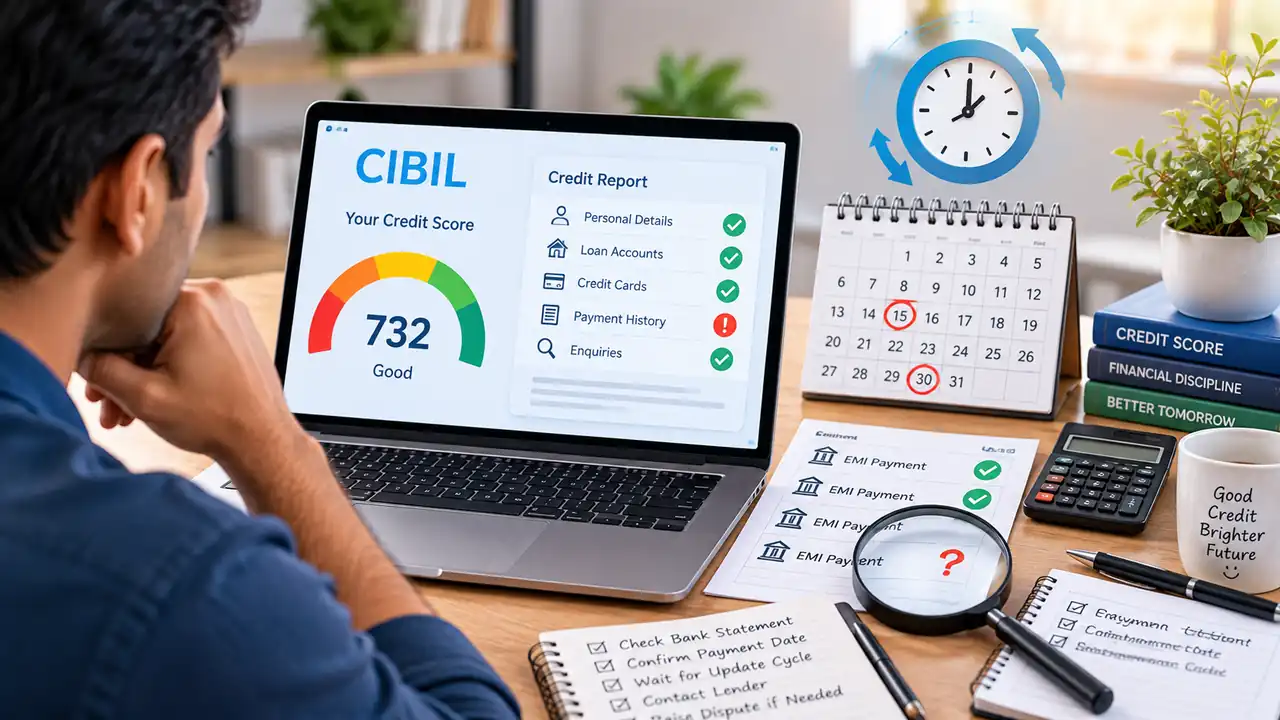
You paid your EMI on time, checked your report a few days later expecting to see it reflected, and found nothing had changed. That gap between paying and seeing it trips up a lot of people. That’s because almost nobody explains that credit bureaus don’t work in real time. A missing entry stops feeling like a mystery and starts looking like something you can just wait out or fix once you know how the update cycle actually works.
Does CIBIL Track Your Payments the Moment You Make Them?
No. This is a major part where most people go wrong. CIBIL doesn’t sit there watching your bank account or your loan portal. It only knows what your lender tells it, and lenders don’t send that information after every single transaction. They submit it after creating a batch and putting it on a schedule. That means there’s always a lag between the day you actually pay and the day that payment becomes visible on your file.
So How Often Does the Update Actually Happen?
Most banks and NBFCs report to the bureau once a month. This timeline is generally connected with their own billing or statement cycle rather than the calendar month. Some lenders have moved to more frequent reporting. They submit data every couple of weeks instead of monthly. However, this also varies a lot from one institution to another. There’s no single fixed date that applies across every lender. That is why two people who paid on the same day can see their reports updated on completely different dates.
Why Would a Payment You Definitely Made Still Be Missing?
Missing payments can happen due to several reasons. However, none of them mean you did something wrong.
Simple timing is the most common reason in this case. If you paid right before or right after your lender’s reporting cutoff, that payment might get scooped into the next cycle instead of the current one, which can push the visible update out by several weeks.
Sometimes the loan itself was never linked properly. If there was a small mismatch in your name, date of birth, or PAN between what the lender has on file and what the bureau has, the system may struggle to match the payment to your profile at all.
Occasionally the lender just hasn’t reported anything for that period yet. Smaller NBFCs, certain digital lending apps, and some cooperative institutions are slower with their reporting pipelines, and a few informal lenders don’t report to bureaus consistently at all.
And every so often it’s a plain clerical slip. Someone entered a wrong amount, missed a row in a batch upload, or the file transfer between the lender and the bureau simply failed that month.
Is the Loan Type a Reason It’s Not Showing Up?
That can also be a reason in many cases. Most loans, like the ones taken through third party apps or buy now pay later products take longer to appear. The same applies to smaller ticket personal loans from newer lenders. That’s because the reporting relationship with the bureau is newer or less automated than what a large bank has in place.
If you recently closed a loan, that closure can also lag behind the actual settlement date.
How Long Should You Wait Before Taking Action?
You must wait for the complete reporting cycle to end. That generally means somewhere between 30 and 45 days from the payment date. A lot of what looks like a missing entry resolves itself once the lender’s next batch goes through. Know that it’s time for you to take action if the payment is still not reflected after the initial window ends.
What Should You Actually Do If It’s Still Missing?
Start with your lender, not the bureau. Ask them directly whether the payment has been reported yet, and request written confirmation, like a receipt or a no dues certificate if the loan is closed. Keep this on hand no matter what happens next.
If the lender confirms they reported it but the bureau’s report still doesn’t show it, you can raise a dispute directly with the bureau through their online correction request process. You must upload proof of payment along with the loan details, and the bureau is required to investigate and respond within a set number of days. That happens once the lender confirms the correction.
You can track exactly when the fix goes through by checking your CIBIL score regularly during this process.
Is There a Way to Avoid This Issue Going Forward?
Not entirely, since you can’t control a lender’s reporting schedule, but you can reduce how often it catches you off guard. Pay a few days before your due date instead of right on it, so you’re not sitting near a cutoff line. Keep every payment receipt for at least a year, since you’ll need it if a dispute ever comes up. And space out your checks: looking every month right after a payment just means staring at the same unchanged number. Checking every six to eight weeks lines up much better with how these cycles actually move.
What’s the One Thing Worth Remembering Through All This?
A missing entry almost never means your payment vanished or that you’re somehow being penalized. It usually just means the paperwork hasn’t caught up with reality yet. Searches like Poonawalla Fincorp CIBIL often lead people to free tools where you can track this yourself instead of waiting for a statement to arrive. Give the cycle time, keep your proof, follow up if it’s overdue, and the record eventually lines up with what you already know to be true, that you paid.