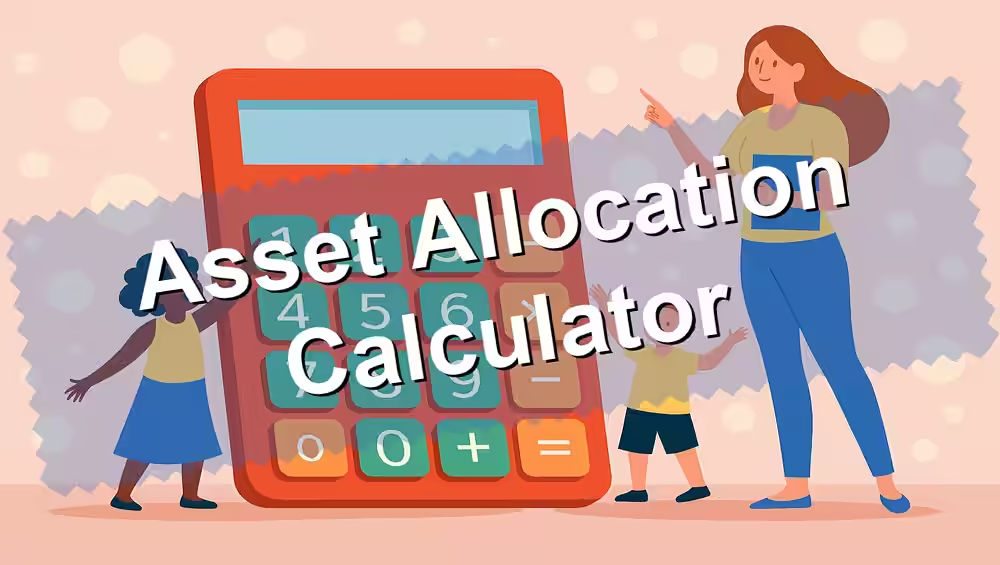
An essential tool for those who wish to diversify their financial portfolio successfully is the Asset Allocation Calculator. The optimal allocation of assets, such as stocks, bonds, cash, and others, can be determined with its assistance. By assisting them in determining their optimal risk-reward ratio, this calculator may help investors make more informed decisions. You need to understand asset allocation if you want to be financially successful over the long term, regardless of your level of investing expertise. You can diversify your investments and make your portfolio more resilient to market fluctuations. The discussion gains structure as the asset allocation calculator leads.
When you invest your money in various assets, you are engaging in asset allocation. With this strategy, you can maximize your return by spreading your investments across multiple locations, each of which will react differently to a single economic shock. Rather than putting all your eggs in one potentially risky basket, diversify your investments. This process is made easier with the Asset Allocation Calculator, so even those without a financial background can utilize it. It’s a helpful tool for observing the interplay and performance of various asset classes in various market conditions.
Meaning of Asset Allocation
You can diversify your investments by spreading them out over several asset classes, such as stocks, bonds, and cash. Based on your financial goals and risk tolerance, you should determine the optimal combination of these assets to achieve a good return-to-risk ratio. A simple way to invest that can help you weather market storms and maximize your returns. It will serve as a guidepost for all of your subsequent investing decisions; consider it the foundation of your investment strategy.
For what reasons is asset allocation critical? Reason being, it aids in reducing danger. The impact of a poor investment can be mitigated by diversifying your holdings across other asset classes. For instance, if your portfolio is heavily invested in stocks and the market has a decline, bonds and real estate may not take a major hit. If you want your investments to pay out in the long run, you need to diversify. Just like a safety net, it prevents you from being overly vulnerable to any one risk.
Examples of Asset Allocation Calculator
Several scenarios call for the utilization of the Asset Allocation Calculator. A more cautious allocation may be appropriate if you want to make a large purchase, such as a home. You have the option of investing 40% in stocks, 50% in bonds, and 10% in cash. You can rest assured that your money will be both protected and grown with this blend. You may make informed decisions with the help of the calculator, which displays the performance of various asset classes in various economic scenarios.
As you near retirement age, you may want to consider protecting your investments. A portfolio consisting of 30% stocks, 60% bonds, and 10% cash can be generated using the Asset Allocation Calculator. Safeguarding your wealth and generating income, both of which are crucial in retirement, are prioritized in this allocation. To ensure you’re making the most prudent long-term financial decisions, the calculator displays the potential benefits and drawbacks of this allocation. It’s a flexible tool that can adapt to your changing requirements and goals, making it a helpful tool throughout life.
How does Asset Allocation Calculator Works?
Your investment horizon, risk tolerance, and desired return on investment are all factors that the Asset Allocation Calculator takes into account. Then, it provides the optimal combination of asset classes based on these features. The amount you wish to invest, the rate of return you desire, and the level of risk you are willing to assume are all pieces of financial information that must be entered. The calculator will then use this information to propose a distribution of your assets.
We can disassemble it. Your financial objectives must be input first. Do you intend to utilize the funds for your children’s college expenses, your own retirement, or a house deposit? There is a specific amount of time and risk you are prepared to put into each goal. After that, you must decide how much risk you are ready to accept. Would you like an investment that is more stable, or are you okay with the market’s inevitable fluctuations? At long last, you’ve reached the investing horizon. For what amount of time do you plan to keep your savings? Based on your objectives and risk tolerance, the calculator will then recommend a portfolio of assets.
Formula for Asset Allocation Calculator
The Asset Allocation Calculator’s methodology takes into account a number of crucial criteria. These factors include your desired level of financial gain, your comfort level with uncertainty, the length of time you have to invest, and the performance of specific asset classes in the past. The optimal asset allocation is recommended by the calculator based on these parameters. In most cases, the approach considers not only your own preferences and the current market situation, but also the expected returns and risks of each asset type.
Example: the expected return might be calculated as follows: (weight of stocks * expected return of stocks) + (weight of bonds * expected return of bonds) + (weight of cash * expected return of cash). Using this approach, you can potentially determine the potential returns on your assets and use that information to build your portfolio. In order to maximize return while minimizing risk, the calculator adjusts the weights of each asset class. It’s not easy, but the calculator simplifies it enough that any investor can use it.
Benefits of Asset Allocation
You can better align your assets with your financial objectives with the help of asset allocation. If you want to save enough for retirement, a house, or your kids’ college, an individual asset allocation plan can be a lifesaver. In addition, it provides a mechanism for routinely reviewing and adjusting your portfolio to keep your investments on course. Asset allocation can also make investing less intimidating by dividing up larger investments into smaller, more manageable ones.
Enhanced Risk Management
Better risk management is one of the many benefits of asset allocation. By spreading your investments among several types of assets, you can mitigate the impact of market fluctuations. With this spread out, you can rest assured that your portfolio will be resilient enough to weather a decline in any one asset class. Having several safety nets that come at you from all directions is like that. This strategy shields investors from market fluctuations, making it ideal during times of economic uncertainty.
Alignment with Financial Goals
The fact that it aligns with your financial objectives is another major perk. Whether you’re saving for immediate expenses or distant dreams, asset allocation can help you organize your investments accordingly. A more careful allocation may be ideal, for instance, if you wish to purchase a home. A more aggressive allocation may be more appropriate, though, if you are saving for retirement. You may rest assured that your investments will contribute to your success by following this tailored plan.
Optimized Returns
You could also find the finest results by allocating your assets. Diversified portfolios are better able to take advantage of market opportunities in a variety of asset classes. When stocks are performing well, for example, they can amass substantial wealth. Conversely, bonds can provide a steady stream of income and security. Rather than putting all your eggs in one basket, diversifying your holdings across several asset classes can increase your return on investment. It’s a prudent way to earn money with minimal risk.
Disadvantages of Asset Allocation
The practice of asset allocation has numerous positive aspects as well as some negative ones. One of the major issues is the potential for poor performance. Strong returns from a single successful asset class may go unrealized by a diversified portfolio. When you see other investors making a killing, this can really annoy you. The potential difficulty in managing a diverse portfolio is an additional drawback. Constant monitoring and replacement is required, which can be laborious and time-consuming.
Transaction Costs and Taxes
Your returns can take a hit if you frequently rebalance your assets because of the taxes and fees you might incur. To rebalance your portfolio, you might, for example, be subject to capital gains taxes on the sale of some assets. The costs associated with purchasing and selling assets also add up. While these costs are inevitable when managing a diversified portfolio, they have the potential to reduce your returns. These fees should be considered when you craft your asset allocation plan.
Impact of Market Conditions
Asset allocation is quite susceptible to market conditions. Depending on your investment horizon, you may need to rebalance your holdings more frequently in times of economic downturn or market volatility. Bonds, for instance, could fare better than stocks during a market slump. Altering the distribution of your assets can be necessary, which can lead to emotional decision-making and stress. Maintaining self-control and concentration on the big picture is essential, especially when going through difficult times.
Emotional Decision-making
A further issue is that individuals may let their emotions dictate their decision-making process. Market fluctuations have the potential to evoke strong emotions, prompting some to make hasty decisions regarding their finances. In the event of a market downturn, you may wish to liquidate your holdings in order to limit further financial loss. When the market is going up, though, you should probably put most of your money into stocks. Your asset allocation strategy can take a nosedive if you give in to these sentiments. You need to maintain self-control and concentrate on the big picture if you want to overcome these emotions.
Recommended Calculators
FAQ
What is Asset Allocation?
Diversifying your holdings among several asset classes, such as equities, bonds, and cash, is known as asset allocation. Depending on your financial objectives and comfort level with risk, you should strike a balance between the two. It’s a simple method for investing that can help you thrive despite market fluctuations. Consider it the bedrock of your investment strategy, the element upon which all your other investment decisions are built.
Why is Asset Allocation Important?
To maximize returns on investments and control exposure to risk, asset allocation is a must. By diversifying your investments, you can mitigate the impact of market changes on your overall portfolio. With this diversification, you can expect more consistent outcomes over time. It also verifies that your assets are aligned with your long-term financial objectives, such as funding a down payment on a house, retirement, or college for your kids. You’ll be well-positioned for success in the long run with this investment strategy.
How Does an Asset Allocation Calculator Work?
To use the Asset Allocation Calculator, enter your investment objectives, risk tolerance, and time horizon. Then, it provides the optimal combination of asset classes based on these features. Your investment goals, desired rate of return, and risk tolerance are some of the financial details that must be input. Then, based on this data, the calculator will propose a distribution of your assets. All investors can benefit from this practical tool because it streamlines the asset allocation process.
What are the Benefits of Using an Asset Allocation Calculator?
Improve your risk management, maximize your investment returns, and maintain focus on your financial objectives with the help of an Asset Allocation Calculator. It illustrates in a nutshell how various asset classes interact with one another and perform under various market conditions. With this information, you can make informed decisions and maximize the return on your assets. Plus, it simplifies investment, which makes the whole process less daunting.
Conclusion
An understanding of how to utilize an Asset Allocation Calculator is crucial for competent investment management. You can use it to build a diversified portfolio that takes into account your risk tolerance and long-term financial objectives. Your investment returns will be more stable and resistant to market fluctuations if you spread them out. With this strategy in place, you can weather market fluctuations and achieve your financial goals in the long run. This conclusion highlights the clarity achieved with the asset allocation calculator.