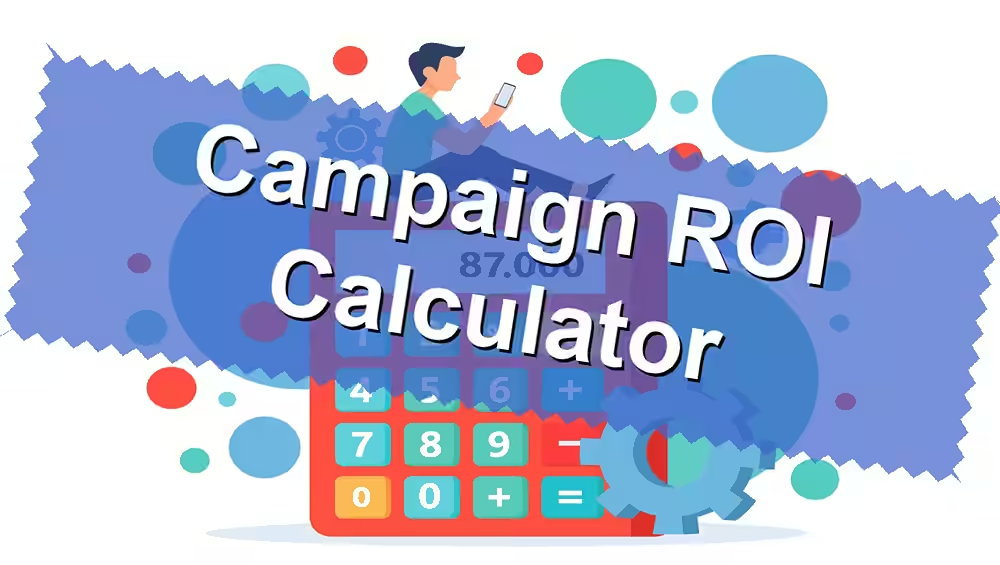
You are uncertain about the return on investment (ROI) of the time and resources you invested in your marketing strategy. In such a case, a Campaign ROI Calculator would be helpful. You can use it to find out how much money your marketing campaigns are producing. To put it simply, it reveals whether or not your marketing expenditure is yielding a positive return. It’s crucial because it enables data-driven decision-making, improved budget management, and, ultimately, increased revenue. The topic gains immediate clarity as the campaign roi calculator leads.
Consider the total amount you’ve invested in a social media campaign. Determine if the campaign’s ROI is justified by the quality of the leads and revenues it generated. You can get a good idea of how effective your campaign was by using the Campaign ROI Calculator to put a number on it. Marketing should be measured in terms of the growth it brings to your organization, not merely in terms of the numbers. Using this calculator, you can see which campaigns are performing well and which ones need improvement.
Meaning of Campaign ROI
One method to evaluate the efficacy of a marketing effort is to calculate its return on investment (ROI). You can see the profit margin of an investment relative to its cost with this metric. Put simply, it provides you with the ROI (return on investment) for each dollar you invest in a campaign. You would have a one hundred percent return on investment (ROI) if your campaign cost $1,000 but generated $2,000 in sales. No sweat, isn’t this a piece of cake? The numbers are important, but they aren’t everything.
Marketing ROI reveals the efficacy of your campaigns. Making a lot of money is important, but so is making sure your efforts don’t cost too much. By calculating return on investment, you can see which campaigns are producing the desired results and which ones aren’t. In order to allocate your marketing budget wisely, this data is crucial. Making the most efficient use of your money is of utmost importance. You might think of it as a way to double-check that your marketing budget is going to work hard for you.
Examples of Campaign ROI Calculator
There are a wide variety of marketing campaigns that can benefit from the Campaign ROI Calculator. You can use the calculator to determine the monetary value of your blog articles, videos, or infographics while running a content marketing campaign. You’ll need to input not only the material’s revenue but also its production and marketing expenses. Afterwards, the tool will make it very clear whether your content marketing strategy is paying off.
One such illustration would be a social media campaign. If you want to know how effective your social media ads are, use the Campaign ROI Calculator. The advertising expenditures and profits will be inputted by you. Use the calculator to determine if your social media budget is yielding a return on investment. For those who manage multiple social media accounts and wish to identify their most productive ones, this is a lifesaver.
How does Campaign ROI Calculator Works?
You can see how much money your campaign made relative to how much it cost using the Campaign ROI Calculator. The calculator will perform the math for you once you input these figures. The formula is straightforward: just take the campaign’s earnings and subtract the campaign’s expense. The campaign budget is then divided by that amount. Your return on investment (ROI), expressed as a percentage, is the result. You may easily gauge the efficacy of your marketing efforts using this method.
Gathering all the campaign-related data is the first order of business. All fees, including those for creating adverts and content, go under this category. You should also record the total amount of money that the campaign earns. Once you have gathered all of this data, you may enter it into the calculator. The tool will then provide you a tangible return on investment (ROI) figure. This metric compares your campaign’s performance to previous ones and lets you know if it’s profitable.
Formula for Campaign ROI Calculator
You can figure out how the Campaign ROI Calculator works with no effort. When you calculate your profit, deduct the campaign’s expenses. The campaign budget is then divided by that figure. Your ROI, expressed as a percentage, looks like this. Division of campaign expenditure by revenue is the formula. Here is a straightforward metric that shows you the financial health of your campaign and how it compares to others you’ve run. It’s an easy way to gauge the efficacy of your advertising.
We can disassemble it. Your campaign earnings are the total amount of money you earned from the campaign. Any measurable outcome, like as sales or leads, might be included here. Your overall outlay for the campaign, including advertising, content creation, and any other associated expenses, is known as the campaign cost. By plugging these figures into the formula, you can quickly determine the campaign’s profit.
Benefits of Campaign ROI
Return on investment (ROI) metrics allow you to maximize your financial resources. If you can identify which campaigns are performing well, you can allocate more resources to them and focus more effort on them. Conversely, you can reduce spending on ineffective initiatives. That way, you know your advertising dollars are going where they’ll do the most good. This will be beneficial for your marketing staff as well as your organization.
Improved Budget Allocation
Among the many benefits of Campaign ROI is the improved distribution of funds. If you know which campaigns are producing the best results, you can allocate your budget more wisely. This means that successful campaigns receive more funding, while unsuccessful ones receive less. It’s a reasonable way to guarantee that your advertising budget is exerting itself to the fullest. On top of that, it enables you to make informed decisions supported by facts, rather than relying on speculation.
Better Communication with Stakeholders
Using campaign ROI, you may demonstrate to stakeholders the worth of your marketing efforts. By demonstrating the return on investment (ROI) of your efforts, you can demonstrate the impact your work has had on the company. Stakeholders will appreciate and trust you more when you do this. You can use it as evidence that your marketing efforts are paying off. Additional funding for future endeavors can be obtained in this way as well.
Higher Roi
Increasing the return on investment (ROI) is the primary goal of calculating campaign ROI. You might increase your investment and focus on campaigns that are performing successfully. In this way, you can be certain that your advertising budget is serving its intended purpose. It’s a reasonable plan to maximize your investment and achieve greater results. On top of that, it enables you to make judgments supported by evidence, which is inherently superior to speculation.
Disadvantages of Campaign ROI
With all its merits, campaign ROI isn’t without its flaws. It could be difficult to understand at first, which is one of the main issues. Acquiring and entering all the necessary data into the calculator can be a time-consuming task. It also requires accurate data, which could be challenging to obtain. Also, if your data is incorrect, your return on investment calculations will be off, and you’ll end up making poor decisions.
Complexity
Campaign ROI can be easily calculated, but gathering and interpreting the necessary data could prove to be a challenge. Particularly for large-scale campaigns or businesses utilizing multiple marketing channels, this is true. You must have a firm comprehension of the material and be proficient in its accurate interpretation. You could have to shell out some cash or hire some specialists to verify your return on investment calculations are accurate if you’re not great with numbers.
Short-term Focus
You risk losing sight of long-term, crucial KPIs like consumer engagement and brand awareness in favor of short-term financial gains from your campaign’s return on investment (ROI). In the long run, this can affect your marketing strategy. When managing your campaigns, you should have the broader view in mind, not merely the immediate financial gain. A well-rounded approach that considers both immediate and distant objectives is necessary for sustained success. Do not put too much stock on return on investment.
External Factors
Rates of return (ROI) could be affected by factors such as seasonality or market conditions. You can end up making poor decisions and the results could vary because of these factors. For example, a campaign’s performance during the holiday season may differ from its performance at a slower time of year. These extraneous factors should be considered while analyzing your return on investment data. A thorough understanding of market and company patterns is essential for obtaining reliable ROI figures.
Recommended Calculators
FAQ
What is the Primary Purpose of a Campaign Roi Calculator?
Finding out how much money your marketing efforts are making is the main job of a Campaign ROI Calculator. With its aid, you can determine whether your marketing budget is yielding a positive return. By calculating your return on investment (ROI), you may make informed decisions regarding your marketing budget.
How Do I Gather the Data Needed for Campaign Roi Calculations?
You need to record all of the expenditures associated with your campaign, including advertising, content creation, and any other fees that may arise, in order to calculate the return on investment (ROI). The campaign’s financial success should also be monitored. This may be anything measurable, like sales or leads. For reliable return on investment (ROI) estimates, check that your data is accurate and up-to-date.
Can Campaign Roi be Used for All Types of Marketing Campaigns?
Email marketing, social media advertising, and content marketing are just a few examples of the many marketing endeavors that can make use of Campaign ROI. Accurate data on the campaign’s expenditures and earnings should be obtained at any costs. The calculator will then display the campaign’s performance. It’s a versatile marketing tool that has many potential applications.
What If My Roi Calculation Shows a Negative Roi?
If your return on investment (ROI) is negative, it means that your campaign is losing money. Reasons for this could include poor targeting, low conversion rates, or high advertising expenditures. You must examine the facts and discover methods to improve the situation. Maybe you should rethink your strategy, reevaluate your target audience, or reallocate some funds.
Conclusion
You may gauge the efficacy of your marketing efforts with campaign ROI. You can examine the efficacy of your efforts in a straightforward and measurable way, allowing you to make data-driven decisions. A look at your return on investment (ROI) can reveal which efforts are succeeding and which ones need improvement. Making the most efficient use of your money is of utmost importance. Additionally, it aids in conveying the worth of your marketing efforts to stakeholders. This ending highlights the simplicity of the campaign roi calculator.