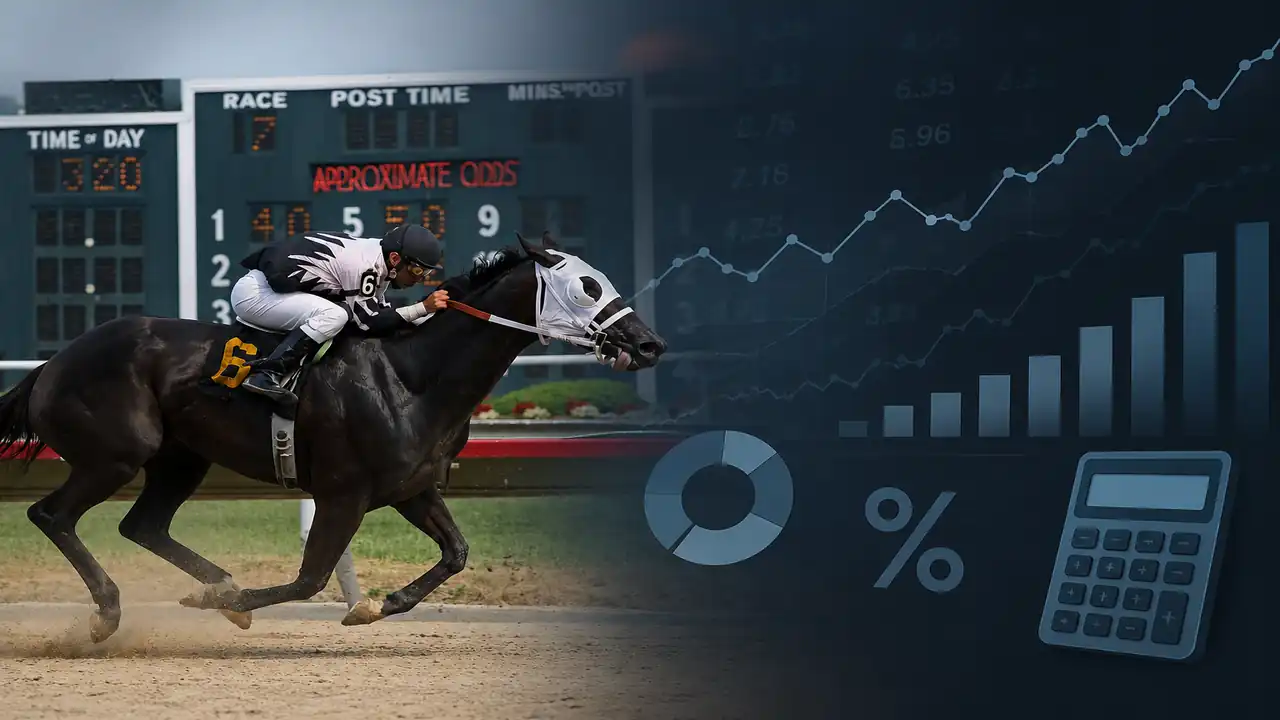
How many times have you been completely right about something and still made a bad financial decision? You knew the company was strong or maybe knew the favorite was the best horse. Then you paid too much for the privilege of being correct.
Just because you think you know the outcome, it doesn’t mean that it is the right decision to make. Horse racing is the perfect example. A horse can be the most likely winner in a race and still be a poor bet because the odds are too short. In other words, you are not getting paid enough for the risk you’re taking.
That’s the main goal with every financial decision. It all comes down to probability and risk management. Sometimes even an underdog horse can be a better bet because the market has underestimated its chance.
So, what can horse racing teach us about probability, odds, and financial decision-making? As it turns out, it can teach us much more than most people think.
Pari-Mutuel Betting Is a Live Market
If you didn’t know, most American horse racing uses pari-mutuel wagering rather than a bookmaker setting a fixed price, and that’s exactly why horse racing works really well with financial decision-making.
So, what is pari-mutuel wagering? Well, to put it simply, all win wagers on a race enter one pool. Place bets go into another; exactas, trifectas, and multi-race bets also have their own pools. The track deducts a percentage for expenses, taxes, and organizing the races, and the rest is divided among the winning tickets.
That’s why the odds move until the race starts. When more money arrives on one horse, its price shortens because a larger number of winning dollars may need to share the pool. If the odds move elsewhere, the odds may rise. So, it is just like financial markets, where the price of company shares moves based on people’s investments.
But the parallel goes deeper. When it comes to horse racing betting, platforms like TwinSpires provide analysis of the races. Such news can influence the odds and betting behavior just like in financial markets.
So, a platform that is offering Del Mar racing picks by TwinSpires functions like equity research for this market. It is very similar to a stock analyst who builds a model to assess whether a company’s current price reflects its true value. That’s the main point of horse racing betting-finding value bets where the horse’s actual probability isn’t well highlighted in the odds.
The Morning Line Works Like an Expert Forecast
Before betting begins, each horse receives morning-line odds.
The morning line is prepared by a track oddsmaker as an estimate of how the public is expected to bet. It is not a guaranteed price and not necessarily the oddsmaker’s personal ranking of the horses. Once actual money enters the pools, live odds replace the forecast.
Think of it as an expert’s prior.
An analyst studies the field, the likely favorite, the trainers, the recent form, and the habits of that track’s betting public. They publish an initial expectation.
Then the market begins updating it.
A horse listed at 8-1 may attract heavy support and start at 4-1. Another listed at 3-1 may drift to 6-1 because bettors find several alternatives more attractive. That’s why you should use the morning line to your advantage.
The comparison with equity research is not exact, but it is useful. An analyst may publish a valuation or price target. The market then absorbs earnings, economic news, investor sentiment, and thousands of individual decisions before producing an actual traded price.
An Overlay Is a Mispriced Probability
Serious handicappers are not simply searching for horses that can win.
They are searching for overlays.
An overlay exists when the market odds are higher than the bettor believes the horse’s true chance justifies. Equibase’s own value-oriented material describes the basic strategy as identifying horses whose track odds sit above the bettor’s estimated fair odds.
Suppose you believe a horse has a 25 percent chance of winning.
That corresponds roughly to fair odds of 3-1.
At even money, the horse may be a bad wager because the market is asking you to accept too little return for the risk. At 6-1, it may be attractive because the offered price implies a much lower chance than your analysis does.
This is very similar to value investing. A good business is not automatically a good purchase at every price. Sometimes a mediocre-looking asset might be a better option.
Public Opinion Is Powerful and Imperfect
Pari-mutuel odds aggregate a large amount of information.
Some bettors study speed figures. Others analyze pace, trainers, jockeys, surfaces, and previous race replays. Large pools combine all of those opinions into one visible price.
Markets can be impressively efficient.
They can also inherit the crowd’s mistakes.
The favorite-longshot bias is one of the best-documented examples in betting research. Across many racing markets, longshots have historically been overbet relative to their true winning chances, meaning their average returns are worse than those of shorter-priced favorites.
Researchers have debated whether this comes from bettors’ attraction to large payouts, probability misjudgment, or other market effects, but the pattern itself has appeared repeatedly.
That’s exactly what’s happening in the financial world, especially when investing in stocks. People are drawn towards exciting stories; they speculate on the future of the company based on the things they see in the news.
Final Thoughts
Horse racing is very similar to financial decision-making. There are countless parallels, but the main idea is that the crowd contributes information; it is all about searching for value and predicting a long shot company/horse that might have the biggest return.
It all comes down to analysis and research-backed decisions just to increase the probability of future outcomes.